
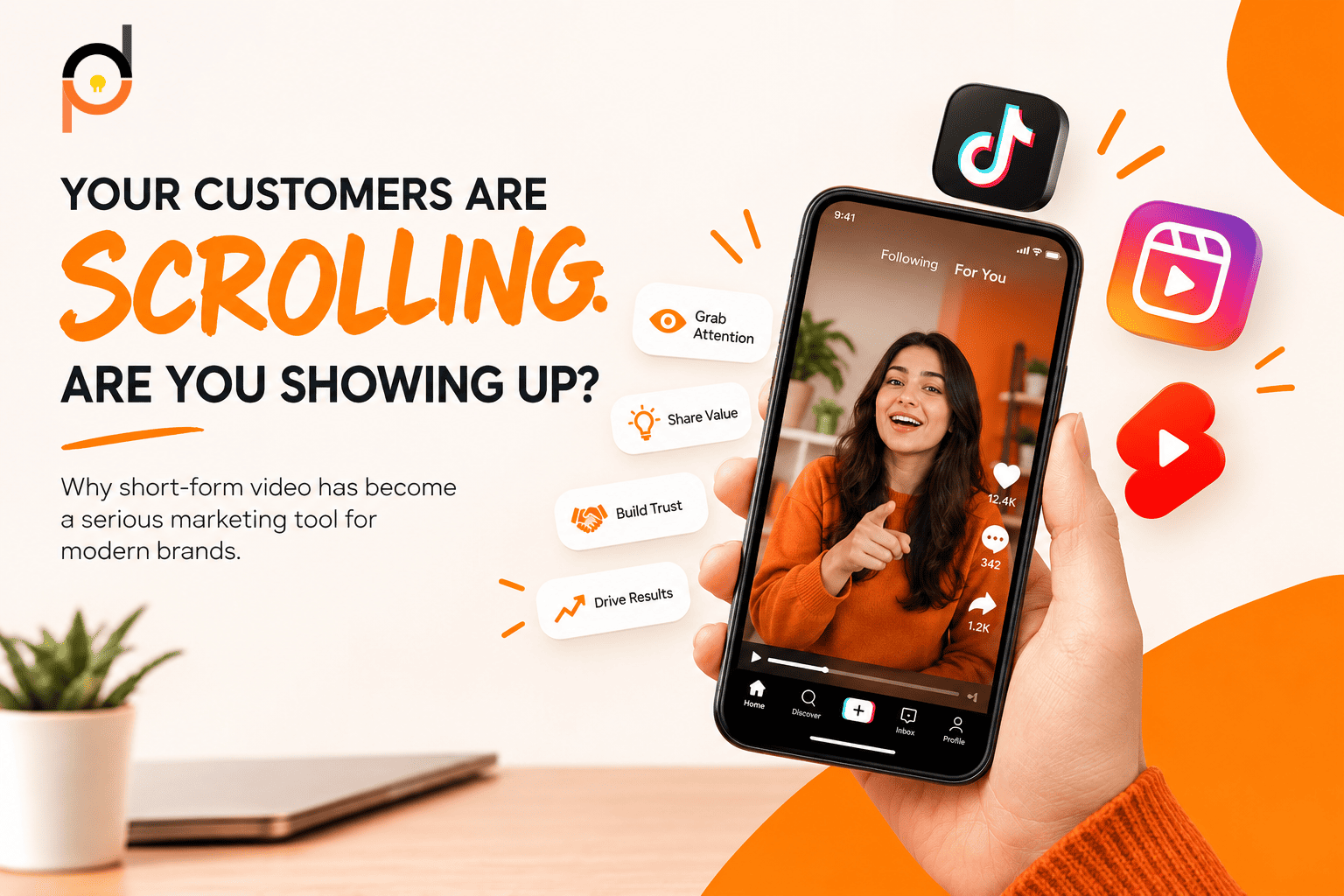
A few years ago, posting a short video was mostly about getting views.
Today, it can be much more than that.
A 20-second Reel can introduce someone to a brand they have never heard of. A quick product video can answer a customer’s question. A simple educational clip can build trust before the customer ever visits a website.
That is why short-form video has become such an important part of digital marketing.
But there is a problem.
Many businesses are creating videos simply because everyone else is doing it.
They copy trends, add a popular sound, put their logo at the end, and hope something goes viral.
Sometimes it works.
Most of the time, it doesn’t.
The real opportunity in short-form video is not simply getting views. It is using those few seconds to capture attention, communicate something useful, and give people a reason to remember your brand.
Think about the way you use social media.
You see a video.
If it looks interesting, you keep watching.
If it takes too long to get to the point, you scroll.
That is the environment businesses are competing in.
Your potential customer might see dozens of posts before seeing yours. You don’t have several minutes to explain why your business matters.
You have a few seconds to earn their attention.
This doesn’t mean every video needs a crazy hook or a dramatic opening.
It means the viewer should quickly understand:
Why should I keep watching this?
That could be a useful tip, an interesting fact, a problem they recognize, a product demonstration, or simply a story worth hearing.
One common misunderstanding is that short videos are only useful for entertainment brands.
That’s not true.
Almost any business can use short-form video.
A clothing brand can show how a product looks when worn.
A restaurant can show how a popular dish is prepared.
A software company can explain one feature in 20 seconds.
A real estate business can give a quick property tour.
A marketing agency can explain why an advertisement isn’t generating results.
An educational institute can answer common questions from students.
The format changes depending on the business, but the principle stays the same:
Give people something worth watching.
You don’t always need a huge idea.
In fact, some of the most useful business videos can be extremely simple.
For example:
“Why are people visiting your website but not buying?”
“3 things to check before running Facebook Ads.”
“What should you post if your business has no new products?”
“Why does your Instagram content get views but no inquiries?”
Each of these is a small problem.
But if your target customer has that problem, your video immediately becomes relevant.
And relevance is more valuable than simply being loud.
Here’s a marketing mistake worth avoiding.
A video gets 500,000 views, and the business owner thinks:
“We need another viral video.”
But what if those 500,000 viewers aren’t potential customers?
A viral video can create awareness, but awareness isn’t automatically sales.
For a business, the better question is:
Did the content reach the right people?
A video with 20,000 highly relevant views can be more valuable than a video with 500,000 random views.
That’s why brands should measure more than views.
Look at things such as:
The right metric depends on the goal of the video.
People decide very quickly whether something is worth watching.
That’s why the opening matters.
But a hook doesn’t have to sound like clickbait.
Compare these two openings:
“Today we’re going to discuss some important marketing strategies…”
and
“Your ads might not be the problem. Your landing page could be.”
The second one creates curiosity.
It gives the viewer a reason to continue.
Good hooks usually do one of a few things:
They create curiosity.
They identify a problem.
They promise useful information.
They challenge an assumption.
Or they start a story.
The important thing is to deliver on the promise. A strong opening followed by useless content will only make people lose trust.
Posting random videos every day isn’t a content strategy.
Before creating videos, businesses should know what they want their content to achieve.
For example, you could divide content into four simple categories:
Teach something useful.
Examples:
Show people who you are.
Examples:
Show what you actually offer.
Don’t just say:
“We provide professional services.”
Show the service.
Show the process.
Show the result.
Not everything needs to feel like an advertisement.
Humor, opinions, relatable situations, and industry-specific trends can make a brand feel more human.
The goal is balance.
AI has made it much easier to create videos.
Businesses can now use AI for ideas, scripts, visuals, voiceovers, editing assistance, subtitles, and much more.
That’s useful.
But it also creates a new problem.
If everyone can generate content quickly, simply producing more videos won’t automatically make your brand stand out.
The creative idea still matters.
The message matters.
The brand voice matters.
And most importantly, understanding the audience matters.
AI can help you produce.
It shouldn’t decide everything about what your brand should say.
People go to social media to discover things, learn, laugh, compare products, and connect with other people.
They don’t open Instagram thinking:
“Hopefully I see a few advertisements today.”
That’s why businesses should avoid turning every video into a sales pitch.
Instead of:
“Buy our service today!”
Try giving people something genuinely useful.
If they repeatedly find your content helpful, they start recognizing your brand.
That recognition can eventually turn into trust.
And trust makes selling much easier.
Another common problem is inconsistency.
A business posts five videos in one week.
Then disappears for a month.
Then comes back with another batch.
That makes it difficult to build momentum.
You don’t necessarily need to post every day.
A realistic schedule that your team can maintain is much better.
For example:
3 useful videos every week
is better than
15 videos this week and nothing for the next six weeks.
The goal isn’t to exhaust your team.
The goal is to create a system that can continue.
If your business hasn’t built a short-form video strategy yet, you don’t need to overcomplicate it.
Start with these steps.
Understand what your customers care about.
What questions do they ask?
What problems do they have?
What mistakes do they make?
What information do they need before buying?
Start there.
Don’t sit down and ask:
“What should we post today?”
Ask:
“What can we help our customer understand today?”
That small change can completely improve your content ideas.
Don’t make every video identical.
Mix educational videos with product demonstrations, behind-the-scenes content, stories, opinions, and customer-focused content.
This keeps your feed from becoming repetitive.
Your videos don’t need to look identical, but people should still recognize your brand.
Use consistent visual elements, tone, messaging, and overall style.
After publishing enough content, look for patterns.
Which topics get shared?
Which videos generate inquiries?
Which hooks keep people watching?
Which topics attract the right audience?
Then create more around what is working.
The internet doesn’t need another million meaningless videos.
It needs better ones.
The brands that will benefit most from short-form video aren’t necessarily the ones with the biggest budgets.
They are the ones that understand their audience and consistently give them a reason to stop scrolling.
Sometimes that reason will be useful information.
Sometimes it will be entertainment.
Sometimes it will be a great story.
And sometimes it will simply be a business showing what it can actually do.
The format may be short.
The strategy behind it shouldn’t be.
At Pak Digit, we help businesses build stronger digital identities through creative content, social media, video editing, graphic design, and digital marketing.
Instead of creating content just to fill your social media calendar, we focus on creating content with a purpose: getting attention, communicating your value, and helping your brand stay memorable.
If your business is ready to take short-form content seriously, Pak Digit can help you turn your ideas into content that works.