
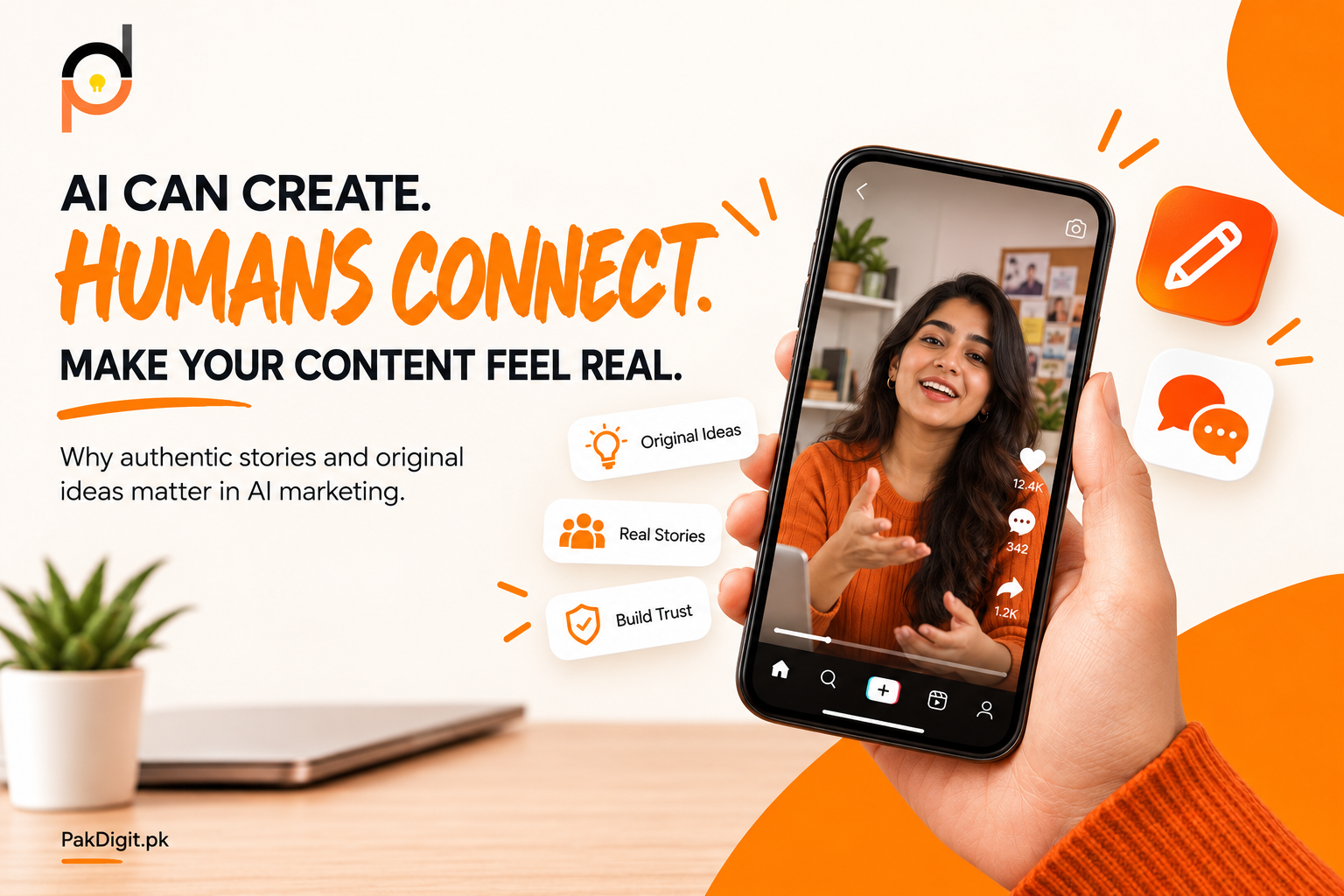
Creating content is easier than ever. Need a social media caption? AI can write one in seconds. Looking for blog ideas or ad copy? There are tools for that, too.
For businesses, this is a huge advantage. Tasks that once took hours can now be completed much faster.
But there is one thing worth thinking about.
When everyone has access to similar tools, how does a business make its content stand out?
Scroll through social media for a few minutes, and you will probably notice the same promises, similar captions, and familiar marketing messages appearing again and again. Some posts look great, but very few actually stay in your mind.
The problem is not AI itself. It is what happens when businesses rely on it without adding their own ideas, experience, or understanding of their audience.
People want useful information. They want brands that understand their problems and communicate in a way that feels natural.
That is why human creativity still matters in marketing. AI can help businesses create content faster, but a meaningful message needs more than a few well-written sentences.
Let’s be honest. Publishing something every day does not automatically make a brand successful.
A business might post regularly, follow the latest trends, and use professional designs, yet still struggle to get attention. Why? Because being visible and being memorable are two different things.
AI has made it easier to produce large amounts of content. However, when businesses use the same prompts, follow the same trends, and repeat the same advice, their content can begin to look and sound alike.
Think about a marketing agency posting, “Take your business to the next level with our innovative solutions.”
Now imagine seeing that same message from five other agencies.
Would you remember any of them?
Probably not.
A stronger approach would be to talk about a problem business owners actually face, such as spending money on ads without getting enough enquiries or attracting website visitors who never make a purchase.
That gives the audience something relevant to think about.
The lesson is simple: don’t publish just because your content calendar says it’s time to post. Give people a reason to stop scrolling.
Customers are careful about where they spend their money. Before choosing a business, they often want to know whether it understands their needs and can deliver what it promises.
Generic marketing messages rarely answer those questions.
For example, saying “We help businesses grow” sounds nice, but it doesn’t explain much.
Compare that with a message like this:
“Getting traffic to your online store but still struggling with sales? Your product pages, pricing, or checkout experience might need a closer look.”
The second message feels more useful because it addresses a specific problem and gives the reader somewhere to start.
This is what good content should do. It should help people understand something, solve a problem, or make a better decision.
Of course, human-written content isn’t automatically trustworthy. A real person can make false claims, too. Trust comes from being honest, sharing accurate information, and delivering what you promise.
When a business consistently communicates this way, customers have more reasons to take it seriously.
Imagine visiting a business’s social media page and finding nothing but product promotions, service lists, and discount announcements.
You might understand what the business sells, but would you feel connected to it?
Probably not.
Now imagine that the same business shares how it started, what it learned from a difficult project, or how it helped a customer solve a common problem.
Suddenly, there is something more interesting to discover.
Stories make marketing feel less like a sales pitch and more like a conversation.
For example, an online store could explain how customers were struggling to find the right product. Instead of simply promoting its collection, the store could create a helpful guide explaining what to look for before buying.
That content provides value even before someone makes a purchase.
AI can help organise a story or suggest ways to present it. But the most useful stories come from real experiences, customer questions, and a genuine understanding of the business.
You don’t need a dramatic success story every week. Sometimes, a simple lesson from everyday work is enough.
A caption can be perfectly written and still say absolutely nothing new.
This is something businesses should keep in mind when creating content with AI.
Let’s take a clothing brand as an example. It can keep posting that its products are stylish, comfortable, and high quality. Those points may be true, but customers have probably heard similar claims from dozens of other brands.
Instead, the brand could share outfit ideas for different occasions, explain how to care for specific fabrics, or show how a new collection was developed.
These ideas give people something useful to explore.
Originality doesn’t mean every post needs to be completely different from everything published before. It means finding a fresh, relevant way to communicate something your audience cares about.
Start by looking at the questions customers ask, the problems they face, and the things they often misunderstand.
Then use those insights to develop your content.
AI can help you brainstorm, but don’t let the first suggestion become the final idea. Add your own thinking before publishing anything.
The aim is not to use complicated words or sound clever. It is to make your message worth reading.
There is no reason to choose between using AI and creating human-focused content. Both can be part of a strong marketing strategy.
AI is useful for brainstorming, organising research, preparing first drafts, and exploring different ways to present an idea. These tasks can save businesses a lot of time.
But someone still needs to make the important decisions.
Which idea fits the brand? Is the information accurate? Does the message sound natural? Will the audience actually find it useful?
These questions require judgement, context, and an understanding of the business.
For example, a marketing team might use AI to generate several campaign ideas. The team can then review them, consider customer feedback, select the strongest concept, and develop the final campaign around its own creative direction.
This is a much more thoughtful approach than publishing whatever a tool produces.
The same principle applies to blog writing, video scripts, social media content, and advertising.
Use AI to make your work easier, not to avoid thinking about what your audience needs.
After all, saving time only becomes valuable when you use that time well.
Many businesses publish blogs because they want more traffic from search engines. That makes sense, but publishing more articles does not guarantee better results.
A blog needs to answer a question, explain a topic, or help readers understand a problem. If it simply repeats information available everywhere else, there may be little reason for someone to spend time reading it.
Suppose you’re writing about social media marketing.
Instead of repeating that every business needs a social media presence, explain how to choose content topics, understand audience engagement, or identify why a campaign isn’t generating enquiries.
That is the kind of information readers can actually use.
SEO is still important. Relevant keywords, clear headings, useful internal links, and a well-organised page help people find and understand your content.
However, keywords should fit naturally into the article. Readers shouldn’t feel as though every sentence was written for a search engine.
Google’s guidance focuses on helpful, reliable, people-first content. Using AI does not automatically make an article bad, just as writing everything manually does not automatically make it valuable.
What matters is the quality of the finished content.
Before publishing a blog, ask yourself one question: Will someone leave this page knowing something useful that they didn’t know before?
If the answer is yes, you’re moving in the right direction.
You don’t need a huge marketing budget or a complicated content strategy to improve the way your brand communicates.
Start with these five practical steps.
Listen to your customers.
Pay attention to the questions people ask before buying your product or hiring your services. These questions can become blog topics, social media posts, videos, and FAQs.
Share what you actually know.
Talk about lessons from your work, common industry mistakes, and the things you’ve learned from real projects. Don’t invent customer stories or results just to make a post more convincing.
Keep your brand voice consistent.
Decide how you want your business to sound. Maybe you prefer a friendly, conversational style. Perhaps your audience responds better to direct, professional communication. Choose a voice that fits your brand and use it consistently.
Review content before publishing.
If you’ve used AI to prepare a draft, read it carefully. Remove unnecessary phrases, repeated points, vague claims, and advice that doesn’t offer much value. Add details that reflect your business and your audience.
Look beyond likes.
A post can receive plenty of likes without generating business enquiries. Pay attention to relevant engagement, website visits, qualified leads, and conversions. These results help you understand whether your content is doing its job.
You don’t need to change everything overnight. Start with one or two improvements and build from there.
Small businesses often compete with companies that have larger budgets, bigger teams, and more resources.
But a bigger budget doesn’t automatically mean better communication.
A local clothing store can share useful styling advice. A digital agency can explain why some marketing campaigns fail. An online store can answer common questions about product selection, delivery, and returns.
These ideas don’t require expensive production. They require an understanding of the people you’re trying to reach.
Small businesses also have the opportunity to build closer relationships with their customers. They can respond to questions, learn from feedback, and create content around the problems their audience actually faces.
AI can help them manage repetitive tasks and work more efficiently. The important part is to use that extra time to improve the quality of their marketing.
Instead of copying what every competitor is doing, focus on what your customers need from you.
Your business doesn’t have to sound like everyone else in the industry. It needs to communicate its own value clearly.
That is how even a small brand can become more memorable.
The Future of AI Marketing Is About Using It Wisely
AI will continue to change the way businesses create content. It will make many marketing tasks faster and help teams explore new ideas.
But creating more content has never been the only goal.
Businesses still need to understand their customers, communicate clearly, and give people useful reasons to pay attention.
A company that uses AI thoughtfully while bringing its own experience, creativity, and judgement to the table has a stronger approach than one that simply publishes whatever a tool generates.
The future isn’t about humans competing with AI at every task. It’s about using technology without losing the qualities that make communication meaningful.
When every business has access to similar tools, the difference comes down to the ideas behind the content and the value it provides.
Don’t just ask how much content your business can create. Ask what your audience will get from it.
That question can change the way you approach marketing.
At Pak Digit, we believe good marketing starts with understanding the business behind the brand and the people it wants to reach.
From graphic design and video editing to website development and store design, we help businesses build a stronger online presence with creative work that supports their goals.
If you’re posting regularly but not seeing the results you expected, it may be time to look beyond the number of posts you’re publishing and focus on the message behind them.
Let’s create marketing that does more than fill your feed. Let’s give people a reason to remember your brand.
Visit PakDigit.pk to explore how Pak Digit can help your business move forward.